Every tin has a story.
Read them all.
Every RELICS metal wallet — thirty-three tins and two Heirlooms — with the stories, palettes and moodboards behind each. Tap any name to jump to its page.


The Notebook
The metal wallets — thirty-five relics and the stories they carry.
Open →Contents
Every name is a door — tap it and the page turns.
Notes from the drawer
Most RELICS designs start as something somebody almost threw away — a matchbox label, a café poster, a woodcut from a book of hours, a Victorian storybook plate.
This notebook is where we keep them: the story, the palette, the details we fell for. Then we put them on metal so they stop getting lost.
Thirty-five relics. Six chapters. Every name in here is a door — tap one and the page turns to it.
— the RELICS team


Inside every tin

- 10 × 6 cmthe cigarette-case silhouette, pocket-sized
- 6–8 cardsplus folded cash, your ID and earbuds
- Twin spring barshold every card flat and in place
- One-push buttonsnaps open, snaps shut
- Solid metal bodyplated in nickel, dent-resistant art print
- RFID-blocking shellkeeps your cards’ data yours
The two Heirlooms are a different build — wider, 15+ cards, a spring-loaded lid and twin retainer bars. See chapter VI, p.43.
Feline Omens


For four hundred years the black cat has been two things at once — the omen you cross the street to avoid, and the charm sailors smuggled aboard for luck. Carrying one is a small act of defiance. You decide what it means.
Omen · Mischief · Luck


Bad Habit
Every good story starts with a bad habit.
No poster. No provenance. Just a black cat on a field of red with a cigarette it never asked permission to light. It doesn’t explain itself, doesn’t apologise — which is exactly why you can’t look away.
“Some people carry a lucky charm. You carry the opposite.”


Absinthe Cat
He drank with the fairy and lived.
Pontarlier, 1898. In the back of a café where the absinthe never stopped dripping, a black cat developed a taste for the green hour — lapping from the poet’s glass, staring at things nobody else could see.
“The poster was printed to sell the liquor. The cat sold himself.”


Crescent Cat
He crossed paths with the moon.
A black cat sitting upright on the tip of a sleeping crescent, one pale star burning over a field of red — poster art from the years when people still nailed horseshoes above the door and meant it.
“Cross his path and the day is cursed — unless you’re the one carrying him.”


Banjo Cat
Boston, 1887. The cat had a gig.
A real photographer, a real studio, and one tabby who — for reasons lost to history — was posed with a banjo and told to hold still. A hundred and forty years of attics and estate sales later: sepia, unbothered, mid-song.
“We don’t decide who becomes a legend. We just put them in your pocket.”


Black Cat Match
A Polish label. Struck everywhere.
A Polish matchbox label from another century — one long black cat mid-stretch, teal lettering gone soft at the edges. Reproduced exactly as it was found, crooked charm and all.
“Some things age better than others.”


Parlor Kittens
Polite society. Feral hearts.
A Victorian storybook plate: five kittens at their lessons — two in ribbon bows, one already sent to the corner in the dunce’s cap, the book long abandoned. Not one of them is sorry.
“Impeccably dressed. Entirely guilty.”


Ramen Cat
Eat loud. Carry quiet.
A woodblock tabby face-deep in a bowl of ramen, red sun behind it, waves breaking around the broth. Ukiyo-e composure, absolutely no table manners.
“For the ones who plan the whole day around lunch.”


Trio Noctis
Three guardians. One pocket.
Three cats keep the night watch across an aged astrological chart — a black cat, a tabby and a jewelled Siamese, ringed by faded Latin and worn star-work. Occult ephemera, shrunk to pocket size.
“One eye on the stars. Three cats on the bed.”
Nocturne


Deco posters loved the moon because the moon was where the party went after midnight. Gold leaf, sage, deep green, a crescent with a face, a sun that refuses to set — the palette of people who do their best living after dark.
Gold leaf · Midnight · Reverie


Moonlit Kiss
She kissed the moon on a dare.
Deco, somewhere around 1925. Gold leaf, a sharp bobbed crop and a crescent with a face — the sort of poster that hung in theatres where the real party started after the final curtain.
“Some romances are strictly nocturnal.”


Moonwalker
She takes the long way home.
An Art Deco panel in gold on sage — a woman stepping along the crescent at midnight, stars thrown loose around her, lilies closing the border. Line work from an age that thought elegance was worth the extra hour.
“Nobody walks the moon in a hurry.”


Crescent Bouquet
She is not coming back down.
Filigreed gold on deep green, ringed with stars: a woman sits cross-legged on the crescent, breathing in a bouquet of pale flowers — the kind of panel once pressed into a powder compact and carried for twenty years.
“Soft on the front. Solid metal underneath.”


Nevermore
She stopped asking it to leave.
A December night, a bird at the chamber door, and a woman in mourning black who has run out of questions worth asking — painted by a century that turned grief into an art form.
“Ask it anything. Nevermore.”


Night Blossom
The garden doesn’t close. It changes staff.
Three pale bats slip between white blossoms on a midnight bough — painted soft as moths, wings raised, tending the flowers everyone else only sees by day.
“Gothic on the surface. Gentle underneath.”


Night Owl
It sees you. Keep it close.
A folk-art owl cutting through stylised pines, eyes lit orange against deep forest green. Woodblock grain, a midnight palette, and the distinct feeling of being watched.
“For night people — the best thinking happens after midnight.”


Midnight Sun
The Sun card, dealt at midnight.
A hand-painted sun with a woman’s face — lashes, freckles, a red lip, that half-lidded stare — throwing its rays across a purple and magenta galaxy. In the tarot the Sun means joy; this one simply decided to keep shining after dark.
“Good fortune, working the night shift.”


Stargazer
The whole sky, under one lid.
An engraving from the age of star atlases: a sun and a moon sharing a single face, ringed planets adrift, zodiac wheels and constellations traced in hair-fine black and gold — the sky as people drew it before anyone had seen it from above.
“For people who still look up.”
Bestiary


Medieval bestiaries paired every animal with a moral. Ours come without one: leopards in a truce, foxes in a pact, a kraken off a harbour wall, two sardines packed head to tail, a butterfly pinned to yesterday’s paper, a unicorn who could leave whenever he likes — and one deeply confused cow.
Predator · Pact · Myth


Leopard Lovers
Two predators, one truce.
Two spotted cats circling each other on midnight navy, head to tail, their tails curling off to opposite corners. A courtship and a standoff at the same time.
“Quietly dangerous. Effortlessly chic.”


Sly Foxes
Thick as thieves. Smug about it.
Two red foxes folded into a soft yin-yang on deep navy — one watching the door, one watching your back. Sly, smug, and a little in love.
“Loyalty, with a grin.”


Kraken
Let it out on your own terms.
An antique octopus sprawled over weathered green — part nautical chart, part warning to sailors, aged like something prised off a harbour wall.
“For deep-water types with a taste for old maps.”


Tinned
Packed tight. On purpose.
Two sardines laid head to tail on soft pink, painted in quick blue-and-silver strokes — the kind of still life that hangs in a seaside kitchen and somehow never looks dated. The catch of the day, shut in a tin.
“Some of the best things come in tins.”


Yesterday’s News
The headlines faded. The wings didn’t.
A giant butterfly inked in black and silver, pressed over columns of yellowed newsprint, with a smaller pale one resting by its wing. Half naturalist’s journal, half scrapbook — the kind of page you find tucked inside a second-hand book.
“Yesterday’s news, kept on purpose.”


Caged Unicorn
Kept, but never tamed.
A white unicorn kneels inside a low round fence, collared and chained to a pomegranate tree, a thousand tiny flowers crowding the ground behind him. Woven around 1500 and argued over ever since.
“Fenced in. Not remotely trapped.”


Bovine Abduction
The pasture was quiet. Then it wasn’t.
An old master’s landscape — gentlefolk on an autumn stroll, painted with all the seriousness of the age — interrupted by a saucer and one levitating, deeply confused cow.
“History, gently abducted.”
Love Letters


Valentines, lace and pressed flowers were made to be given once and lost in a drawer. We put them on metal instead — the sentimental kept for good, the fragile made pocket-proof. And one poppy that refused to be pressed.
Vow · Bloom · Keepsake


Swan Song
Swans mate for life. So does metal.
Two swans meet until their necks close into a heart, framed in engraved lace — drawn line by patient line, from the years when a promise took all afternoon to make.
“One vow, kept in metal.”


Cupid’s Call
He never misses. He just waits.
A curly-haired cherub mid-flight, ribbon tangled around his wings, sounding a tiny trumpet inside a hand-drawn heart — cream on post-box red, straight off a penny valentine.
“Sent once. Kept forever.”


Wildflower Press
Somebody pressed these in 1904 and forgot.
Poppies, cosmos and thin summer grasses laid out the way a botanist would — flattened between pages and shut inside a book nobody opened again for a hundred years.
“Every flower here died long ago. They simply refused to fade.”


Acid Poppy
One flower, turned all the way up.
A magenta poppy the size of the entire frame, opening against orange heat-haze that refuses to sit still — the visual language of a decade that printed its posters to be read across a dark room.
“Botanically, a poppy. Optically, a dare.”


Cosmos Garden
A whole summer on one small lid.
A painted bed of cosmos in full collapse: coral, magenta, violet and dusty pink crowding each other out of the frame, with monarchs and small blue butterflies picking through them. Cosmos is the flower that grows best in poor soil and refuses to be arranged — it does what it likes, and it looks better for it.
“A whole summer, pressed onto one small lid.”
Vanitas


The Dutch painted flowers beside skulls to prove the flowers were dying. A woodcut told you to remember your last days; a druggist’s label warned you off the arsenic; a 1936 poster tried to scare you straight. Every one failed as a warning and survived as art.
Memento · Vice · Still life


Memento Mori
Remember your last days.
A woodcut from a book of hours, cut when death was a household fact and the printer saw no reason to soften it. Twin skeletons flank the altar beneath two Latin lines — MEMORARE NOVISSIMA TVA, and SIC TRANSIT GLORIA MVNDI.
“Sic transit gloria mundi — and your receipts.”


Gothic Beetle
Everything wilts. The beetle stays.
An iridescent scarab set dead-centre in an oval of roses, poppies and pale blooms, painted against pure black — the Dutch masters’ oldest trick: beauty arranged around a reminder.
“Flowers rot. Metal doesn’t.”


Reefer Madness
They funded a film to frighten you.
Nineteen thirty-six. A church group paid for a cautionary picture, and the printers gave it a green devil, a headline in full scream and type that refuses to sit still. It failed as a warning and succeeded as a poster.
“The panic aged into camp. The artwork never blinked.”


Arsenic Apothecary
Mind the small print.
A druggist’s label from the days when arsenic sat on the shelf behind the counter: skull and crossbones, an antidote set in tiny type — tincture of iron, ammonia water, bicarbonate of soda — and the Columbia Pharmacy of Spokane signing off in fancy borders.
“All warning, no poison.”


Black Sun
Every sun sets. These were gilded first.
Gilded skulls set inside baroque sunbursts on jet black, with smaller gold suns and sprays of roses drifting between them — the gold-leafed memento mori of chapel ceilings, scaled down to a pocket.
“Grim subject. Excellent taste.”
Heirlooms


Before the card case there was the cigarette case — engraved, spring-lidded, handed down. These two keep the silhouette of a slower century and quietly change what goes inside.
Engraving · Chrome · Inheritance


Medallion
A wallet from a slower century.
Before the card case there was the cigarette case — mirror-polished, spring-lidded, engraved edge to edge. The Medallion keeps that silhouette and that engraving in polished chrome, sized up to hold 15+ cards and folded cash flat.
“The case your grandfather carried — honestly bigger.”


Onyx
Slim, quiet, impossible to ignore.
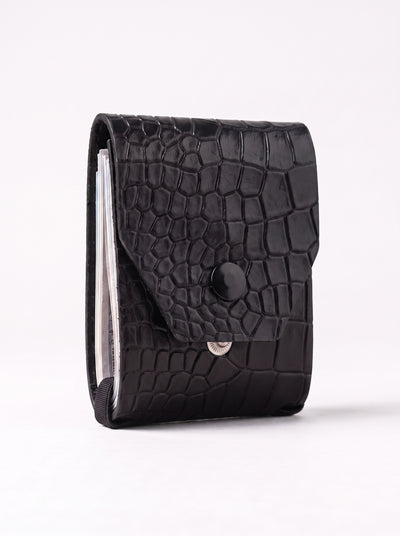
The old cigarette-case silhouette, wrapped in jet-black croc-embossed leather over a steel frame. A spring-loaded lid that opens with one thumb, and twin retainer bars that keep 15+ cards — or cards and folded bills — flat.
“The heirloom, dressed in black.”
Fresh ink
Six new designs from Drop 06, one from Drop 07 — and two old favourites back in stock.
The Index
 Bad Habit6
 Absinthe Cat7
 Crescent Cat8
 Banjo Cat9
 Black Cat Match10
 Parlor Kittens11
 Ramen Cat12
 Trio Noctis13
 Moonlit Kiss15
 Moonwalker16
 Crescent Bouquet17
 Nevermore18
 Night Blossom19
 Night Owl20
 Midnight Sun21
 Stargazer22
 Leopard Lovers24
 Sly Foxes25
 Kraken26
 Tinned27
 Yesterday’s News28
 Caged Unicorn29
 Bovine Abduction30
 Swan Song32
 Cupid’s Call33
 Wildflower Press34
 Acid Poppy35
 Cosmos Garden36
 Memento Mori38
 Gothic Beetle39
 Reefer Madness40
 Arsenic Apothecary41
 Black Sun42
 Medallion44
 Onyx45
To whoever is holding this,
Thank you for reading this far. Most things in your pocket are designed to be replaced — the receipts, the cards, the phone. We wanted one thing in there to be the opposite.
Most tins in this notebook carry a piece of print that outlived the people who made it. We hope yours outlives the cards you put in it — and that somebody, one day, finds it in a drawer and asks where it came from.
Tell them the story. It’s all in here.
With love and a little ink,
— RELICS
Collect the set.
Small, strange, beautiful print — carried in metal.
← Back to contents